From Laravel tutorials to building my own video editor
When I was around 11, I started becoming interested in video editing. I found it fascinating that you could take some footage, move things around, add effects and turn it into something completely different. But I was just as interested in the software making that possible.
I wanted to build a video editor of my own.
That idea stayed with me, although it would be years before I started doing something serious about it. In the meantime, I became a developer, started making programming tutorials, and spent enough time recording and editing videos to develop a much clearer idea of what I wanted.
ZXN Studio grew out of both things: a childhood fascination with how video editors work, and the practical frustrations of making more than 500 videos.
Making tutorials, and constantly changing tools
You might know me as Tilly The Coder. Around age 20, I started producing tutorials around Laravel and Filament. That grew into hundreds of videos, including projects such as building content management systems with Filament and applications with Livewire. Teaching through practical projects became a big part of my work in the community.
In October 2024, I was also included in the first group of Filament Ambassadors, alongside other creators and contributors sharing their knowledge of the framework.
But despite spending so much time making videos, I could never quite settle on a recording and editing workflow.
I tried everything from OBS to Tella for recording. For editing, I moved between tools including Premiere Pro and Final Cut Pro, and used Recut for cutting silences. I kept looking for a combination that would make the whole process feel comfortable, rather than solving one part of it and leaving me to figure out the rest.
It was not that these tools had nothing to offer. I just never found a workflow I could stick with.
When you are making hundreds of tutorials, that becomes frustrating. Recording is only one part of the work. You still need to cut mistakes, tighten up explanations, arrange what the viewer sees and get the finished video ready to publish. I wanted to spend more of my attention on the tutorial itself, rather than on the process of getting it through several applications.
I also wanted something that worked well for shorts. A longer programming tutorial and a short clip for social media need different pacing and layouts, but I did not want them to feel like completely separate production processes.
What I kept coming back to was an all-in-one solution: somewhere I could record, edit and finish a video, with enough flexibility to make it my own.
Eventually, that connected with the idea I had carried around since childhood. I still wanted to build an editor, and now I had a very specific reason to do it.
Finding the right foundation
I started exploring the idea for ZXN Studio in June 2026. By July, I was heavily involved in building it.
The first approach used Tauri. For the recorder I was trying to build, it did not work as well as I needed, so I moved to Swift. That worked fine, but I wanted a cross-platform direction for the project rather than tying the whole application to one platform.
I eventually moved the editor to NativePHP.
That brought the project closer to the tools I already knew through my development work and tutorials. NativePHP provides a way to build desktop applications using Laravel and familiar web technologies, with the current desktop implementation using an Electron shell. It meant I could use that experience as a foundation while working on a very different kind of application.
Part of the appeal was also looking ahead. SuperNative currently powers NativePHP’s mobile architecture, and I would like to make use of it on desktop when that becomes available. That future possibility was one of the reasons I chose to move in this direction.
The technology changed as I explored the project, but the reason for building it stayed the same. I wanted recording and editing to feel like connected parts of making a video, rather than separate jobs that happened to involve the same footage.
Keeping the recording editable
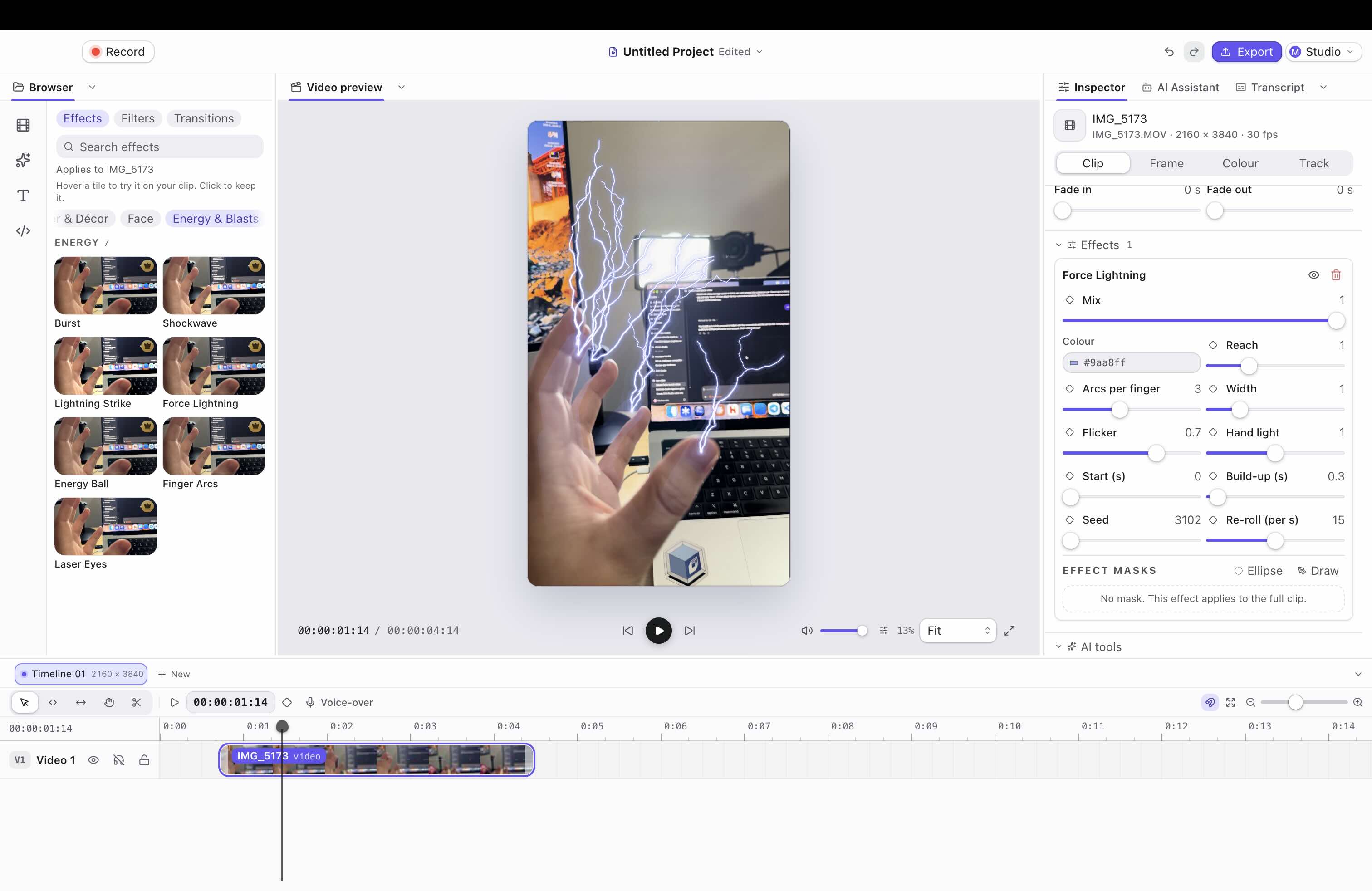
ZXN Studio brings screen recording and video editing into the same workspace. You can record your screen, camera and microphone, then work with the screen and camera footage as separate clips on a multi-track timeline. That separation matters because the camera is not permanently baked into the recording: you can move or resize it afterwards. From there, you can trim and split clips, layer footage and audio, add titles, transitions and effects, and remove backgrounds locally on your Mac. The idea is to keep the process together without taking away the ability to change the composition as you edit.
For a programming tutorial, that flexibility has a very practical purpose. A camera overlay might look fine at the start of a recording, then get in the way of the code you need to explain. Being able to change the layout afterwards is much more useful than having to get every visual decision right before pressing record.
There is also a part of the project that brings my interests in coding and video even closer together. ZXN Motion supports motion graphics written in editable TSX, which can be rendered into the video. As a developer, being able to work with animation through code is a particularly enjoyable connection between the two.
Still, the question I keep returning to is not how many features I can fit into an editor. It is whether the things I am building help someone get from an idea to a finished video with less interruption.
A project that grew out of the community
There is something satisfying about building this with tools connected to the community I have spent so much time creating tutorials for.
Laravel and Filament gave me subjects to teach. Making those tutorials gave me first-hand experience of the recording and editing problems I wanted to solve. NativePHP then became part of how I could approach building the solution.
ZXN Studio is now included in the NativePHP showcase, alongside other applications built by developers taking their PHP skills beyond the browser. Seeing it there makes the project feel like a contribution to that wider exploration, as well as something I wanted to build for myself.
I am grateful to Larabelles for the opportunity to share the story behind it. A project announcement can show what an application does, but it rarely explains why someone cared enough to start building it.
For me, that reason goes back much further than June.
At 11, I wanted to understand how a video editor worked. After making hundreds of tutorials, I had a much clearer idea of how I wanted one to work for me.
ZXN Studio is where those two interests finally came together.